
Reviews, Views and Adventures in Content Creation

Showing posts with label Phil Grabsky. Show all posts

Saturday, December 8, 2012

Three Great Documentaries


This is the second in a series of behind-the-scenes blogs about the story behind the making of a documentary - in this case, my film, "Life Online," the story of a family in Florida that's uniquely dedicated to the "YouTube" lifestyle.   Interested? Donate at http://tinyurl.com/acegrw4

These blogs and vlogs will trace the evolution  of this project as I prepare, shoot and edit "Life Online." I hope these prove helpful to aspiring filmmakers.


There are a number of films that have inspired my upcoming documentary, "Life Online," the story of a family that has embraced the YouTube "lifestyle."  With three boys and their mom all creating content for their individual lifestyles, and all family members contributing to their non-stop production "studio," this film will offer a great perspective on why more and more people are deciding to express themselves publicly through YouTube and social media.  "Life Online" asks, 'What happens to family life when there's an audience to serve?'

Three documentaries in particular loom large in my decision to tackle this project:

Considered by some as the original 'reality show,' "An American Family" was a multi-part public broadcasting series featuring the life of a "typical" suburban family in Santa Barbara in the early 1970's.  They turned out to be anything but typical, as their family literally disintegrated under divorce and a series of dramatic revelations by each family member.  Unlike today's "reality" programs, this documentary wasn't subtlety moved along or even scripted by the producers.  Events simply unfolded from May to September of 1971, during which time Producer Craig Gilbert's team shot hundreds of hours of 16mm film.   It's also worth noting that shooting a film like this in the early 1970's required cumbersome camera, lighting and audio equipment, creating a  disruptive environment that some suggest may have been a provocative factor (among others) in the family's demise.

I'll long been fascinated with the patience, dedication and trust necessary to create "An American Family."  Unlike so many of today's "reality" shows that pretend to portray life as it unfolds, this program felt authentic.

Oscar-winning director Michael Apted, who has moved back and forth between feature films and documentaries, continues to create the "7 Up" series of feature documentaries, an extraordinary portrait of a group of ethnically and economically diverse Britons whose lives he has revisited every seven years since they were seven years old - now, over fifty years.  Inspired by the Jesuit saying, "Give me a child until the age of seven and I will give you the man," this is a uniquely revealing portrait of human nature.  The "7 Up" films not only prove that personality may indeed be in place, but they're also an extraordinary tribute to the resilience of human beings in general.  Apted shows a respect for his subjects that offers a great example for any filmmaker. (Here's a review of the latest film in the series, "56 Up")
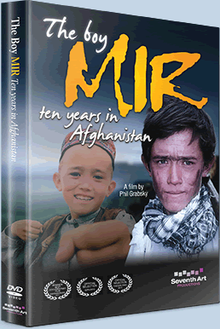
Respect for the subject was the central factor in the effectiveness of "The Boy Mir." Director Phil Grabsky's film follows a peasant boy in Afghanistan from ages eight to eighteen, during the dramatic events of the last decade, as he and his family struggle to survive amidst the chaos and then emerging new freedoms transforming their world.  Grabsky returned to Afghanistan periodically over ten years to tell Mir's story, creating a film that personalizes a story that exists for the West mostly in impersonal headlines.   (Here's my review of the film; I had an opportunity to interview Grabsky about 'The Boy Mir. ' Here's my blog, 'The Minute You Pull Out a Camera, You're Intervening').  

"An American Family," the "7 Up" series and "The Boy Mir" are varied in style and approach - but share three important elements that, I feel, make them effective films: Dedication of the filmmakers, trust and mutual respect between the filmmakers and their subjects, and uncommon patience.  If I have the opportunity (Consider contributing here) to create "Life Online," that's what I'll be striving for.

Saturday, August 27, 2011

The Minute You Pull Out a Camera, You're Intervening

(You can read my original review of The Boy Mir here)

I recently had the opportunity to interview Phil Grabsky, director of The Boy Mir: Ten Years in Afghanistan," a new feature documentary that offers an unusually intimate portrait of a young boy growing up in the remote reaches of Afghanistan over the last decade. From eight to about eighteen, we watch Mir's life unfold with his family, as they struggle to survive, distant but impacted by the battle's for Afghanistan's future. This is actually Grabsky's second feature film about Mir. The award-winning "The Boy Who Plays on the Buddhas of Bamiyan" (2004), followed Mir and his family during a single year as they struggled to survive in the aftermath of Taliban rule, living in the shadow of what had been the tallest sculptures in the world - the Buddhas of Bamiyan - which the Taliban had destroyed to international outrage in 2001.


 Photo used by permission
A large part of the appeal of both films is Mir himself - an intelligent, charismatic boy facing daily hardships that force him to often interrupt his schooling to work in the fields to help sustain his family. As he grows into a teenager, his hopes dreams, humor - and even his material wishes (a bike, a motorcycle, a cell phone) will seem familiar to kids and adults the world over.

Grabsky, based in Brighton, U.K., remembers the very event that triggered both Mir films. On July 2nd, 2002, a U.S. aircraft accidentally fired on an Afghan wedding, perhaps reacting to perceving celebratory gunfire as a threat. The attack killed and wounded dozens - and haunted Grabsky, "I thought to myself, alright, step back from that. Imagine your own wedding day, my wedding day, out of the blue sky - they don't even see this plane - out of the blue sky, one minute everyone's dancing and happy, and the next minute people are literally in bits."

"I thought, who are the Afghans? They can't all be terrorists, they can't all be mute women behind burkhas. And I was just interested, and I thought I'lll just go and find out myself."

Tuesday, June 28, 2011

Blogcritics Documentary Review: "The Boy Mir"


Image Used by Permission

(Check out my interview with Phil Grabsky, director of "The Boy Mir")

This review originally posted on Blogcritics.org


The Boy Mir – Ten Years in Afghanistan, a feature documentary now making the rounds at film festivals worldwide, offers an intimate perspective of daily life in Afghanistan rarely seen by western audiences. Over a period of a decade, British filmmaker Phil Grabsky returned repeatedly to this war-ravaged country to visit Mir, a young boy living with his family in remote villages far – but not untouched – by the battles raging throughout the country.

Only eight years old when we first meet him, Mir grows into a young man, with hopes and dreams of a better for himself and his family. His family, at times, is literally dirt poor –living in mountain dug-outs high above the plain, struggling daily to survive. He understands that school is the key to his future, but his attendance is spotty and inconsistent – he must tend to his family’s livestock more and more, as his father is in failing health and is less able to perform the arduous work necessary for the family to survive.

Mir’s life will seem surprisingly familiar to the western audience. Material desires – for bikes and motorbikes – will dominate his thoughts for a time, and as he grows older and the family’s life marginally improves, he dominates use of the family’s new cell phone with calls to girls in distant towns. As he grows, he also develops an awareness of his situation, his future, and what he must to succeed beyond his family’s bare existence.

National and international politics are distant here – but never out of mind. They’ve fled to the remote mountain settlement because of the incursion of the Taliban; they return to when the Taliban are on the run. These are simple people struggling to survive in a world hopelessly beyond their control. They’re not religious zealots, or freedom fighters. Like most people around the world, they only want to live their lives in peace.


Knowledge of the Americans and British are mostly anecdotal in this remote enclave. During one tribal meeting, an attendee struggles to understand the relationship between the two allied nations, asking if the U.K. is part of the U.S. (he's corrected by wiser villagers).   When several American troops in a pair of military vehicles tentatively visit the town, villagers are gracious, but puzzled by the visit, and the peculiar gifts they’re given by the American soldiers.

The Boy Mir – Ten Years in Afghanistan is actually a follow-up to Grabsky’s award-winning film, The Boy Who Plays on the Buddhas of Bamiyan, featuring Mir and his family when they lived in the shadow of what once were gigantic and ancient statues of Buddha, blown to rubble during the Taliban’s reign.

Mir – the boy and the film - has an abundance of energy and hope for his future – though the road ahead is still unclear. For anyone struggling to truly understand the people of Afghanistan, this film provides an exceptional and moving introduction.